Concentrating valuable biological samples without losing the molecules you need is a common challenge in laboratory research. Proteins, antibodies, enzymes, and nucleic acids often require concentration, purification, or buffer exchange before downstream analysis. Choosing the right ultrafiltration device can make these processes more efficient while helping preserve sample integrity.
For researchers looking for a reliable centrifuge filter in Australia, CoPure offers the Briscale™ 0.5 mL Centrifugal Filter with a low-binding regenerated cellulose (RC) membrane, designed for concentrating small-volume biological samples.
A centrifugal filter is a laboratory device that uses centrifugal force to separate molecules according to their ability to pass through an ultrafiltration membrane.
During centrifugation, smaller molecules and solvent pass through the membrane into the collection tube as the ultrafiltrate. Larger molecules are retained above the membrane as the concentrate, also called the retentate.
This technique is widely used for protein precipitation, protein concentration, nucleic acid purification, desalting, buffer exchange, and biomolecule preparation.
The Briscale™ Centrifugal Filter is designed for concentrating proteins and biological samples containing antigens, antibodies, enzymes, nucleic acids, and microorganisms.
Its vertical membrane design provides an effective filtration area of 0.6 cm², supporting rapid concentration and concentration levels of up to 80-fold under suitable conditions.
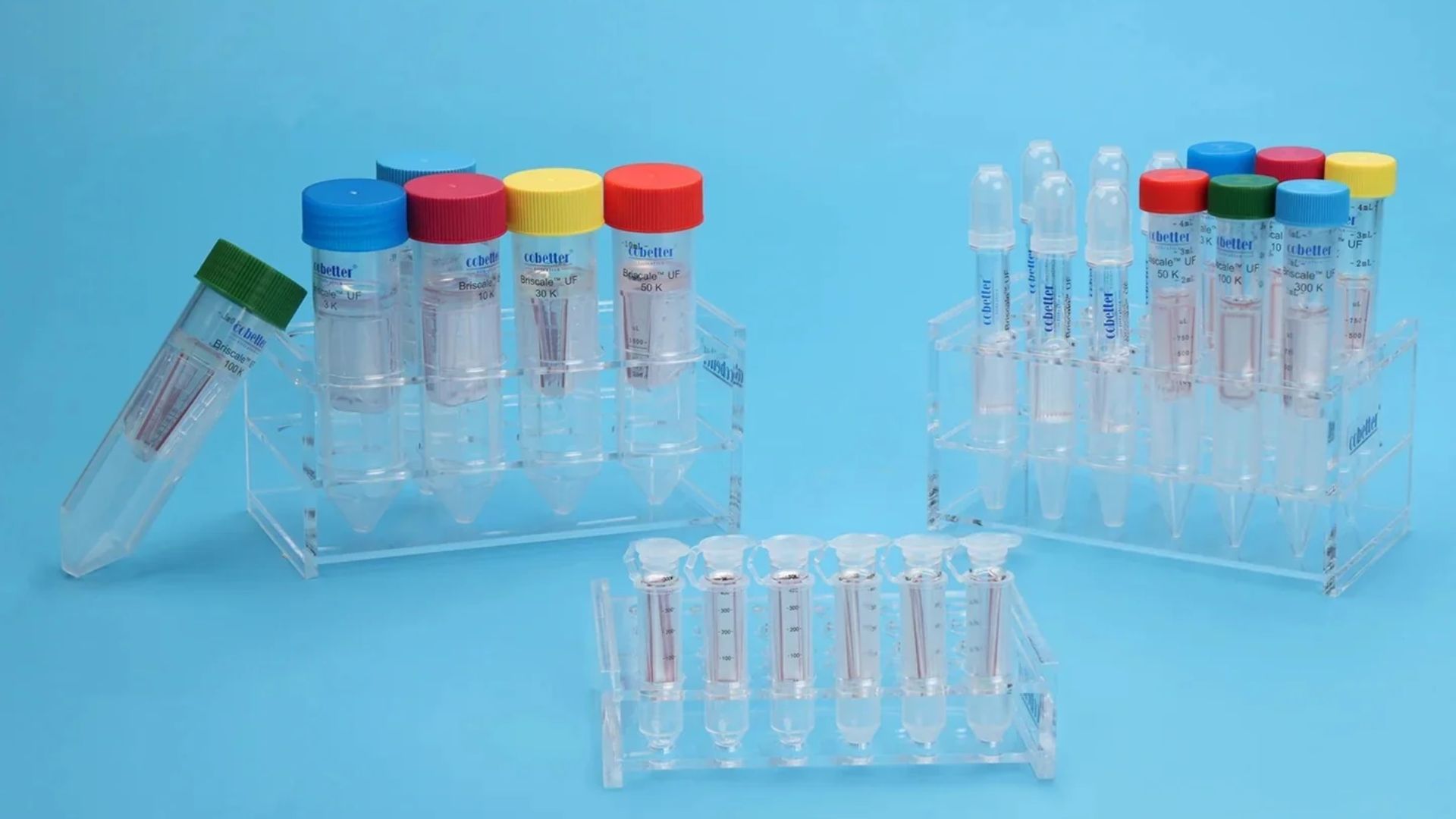
The device consists of a lid, ultrafiltration unit, and centrifuge tube. After centrifugation, the concentrate can be collected from the filter device using a pipette, while the ultrafiltrate remains in the collection tube for further analysis.
High protein recovery: The regenerated cellulose membrane and smooth inner-wall design minimise protein adsorption, supporting a protein recovery rate of more than 90% under suitable conditions.
Low-binding RC membrane: Regenerated cellulose is suitable for many protein and biomolecule applications where minimising nonspecific binding is important.
Multiple MWCO options: Available molecular weight cut-offs (MWCOs) include 2, 3, 10, 30, 50, 100, and 300 kDa, helping researchers select a suitable membrane for their target molecules.
Broad chemical compatibility: The membrane offers a specified pH compatibility range of pH 1–14, subject to compatibility with the sample, device materials, and operating conditions.
Easy sample monitoring: A translucent housing, graduated volume markings, and colour-coded caps make sample identification and volume monitoring easier.
The Briscale™ filter supports a range of research applications, including:
For laboratories evaluating membrane filters in Australia, centrifugal ultrafiltration offers a practical option when sample volumes are limited and recovering valuable biomolecules is a priority.
Selecting the correct molecular weight cut-off is essential for effective ultrafiltration. A useful starting point is to choose an MWCO approximately two to three times smaller than the molecular weight of the target molecule. This is a general selection guideline rather than a guarantee of retention, because molecular shape, membrane interactions, and solution conditions can affect performance.
| Filter MWCO | Suggested Target Molecular Weight |
|---|---|
| 2 kDa | 4–10 kDa |
| 3 kDa | 6–20 kDa |
| 10 kDa | 20–60 kDa |
| 30 kDa | 60–100 kDa |
| 50 kDa | 100–200 kDa |
| 100 kDa | 200–500 kDa |
| 300 kDa | 600 kDa and above |
For example, when concentrating a protein with a molecular weight of approximately 50 kDa, a 10 kDa MWCO membrane may be a reasonable starting point. Researchers should verify retention and recovery using their specific sample and experimental conditions.

The Briscale™ centrifugal filter has a maximum sample volume of 0.5 mL when used with a fixed-angle 45° rotor. Its recommended centrifugation speed is 4,000–5,000 × g, with a minimum retentate volume of approximately 15–20 µL.
The membrane is made from regenerated cellulose, with an HDPE lid, GPPS ultrafiltration device, and polypropylene centrifuge tube. The product is supplied non-sterile, intended for research use only, and packaged individually in double polyethylene bags in a pack of 24.
Manufactured under an ISO 9001:2015 quality management system and for use in conformance with cGMP, the product is supplied with COA/COQ documentation. Its stated endotoxin specification is less than 0.25 EU/mL by aqueous extraction using the LAL test in accordance with USP <85>.
Effective sample concentration depends on more than centrifugation speed. Membrane material, MWCO, sample compatibility, and protein recovery all influence the outcome.
With its low-binding RC membrane, multiple MWCO options, and compact 0.5 mL format, the Briscale™ Centrifugal Filter supports small-volume biomolecule concentration and purification workflows.
For laboratories seeking a centrifuge filter in Australia, CoPure provides a solution designed to support practical, efficient sample preparation in research applications.
What is a centrifugal filter used for?
Centrifugal filters are used to concentrate proteins and other biomolecules, exchange buffers, desalt samples, and separate molecules according to membrane retention characteristics.
What is MWCO in ultrafiltration?
MWCO, or molecular weight cut-off, describes a membrane’s nominal ability to retain molecules of a particular molecular weight. It is a selection guide, not an absolute molecular-size boundary.
What is the advantage of regenerated cellulose membranes?
Regenerated cellulose membranes typically have low nonspecific protein binding, which helps improve recovery of valuable biological samples.
How much sample can the Briscale™ filter process?
The Briscale™ 0.5 mL model has a maximum sample volume of 0.5 mL when used with the specified fixed-angle rotor.
For Further Enquiry Contact- sales@copure.com
Share: