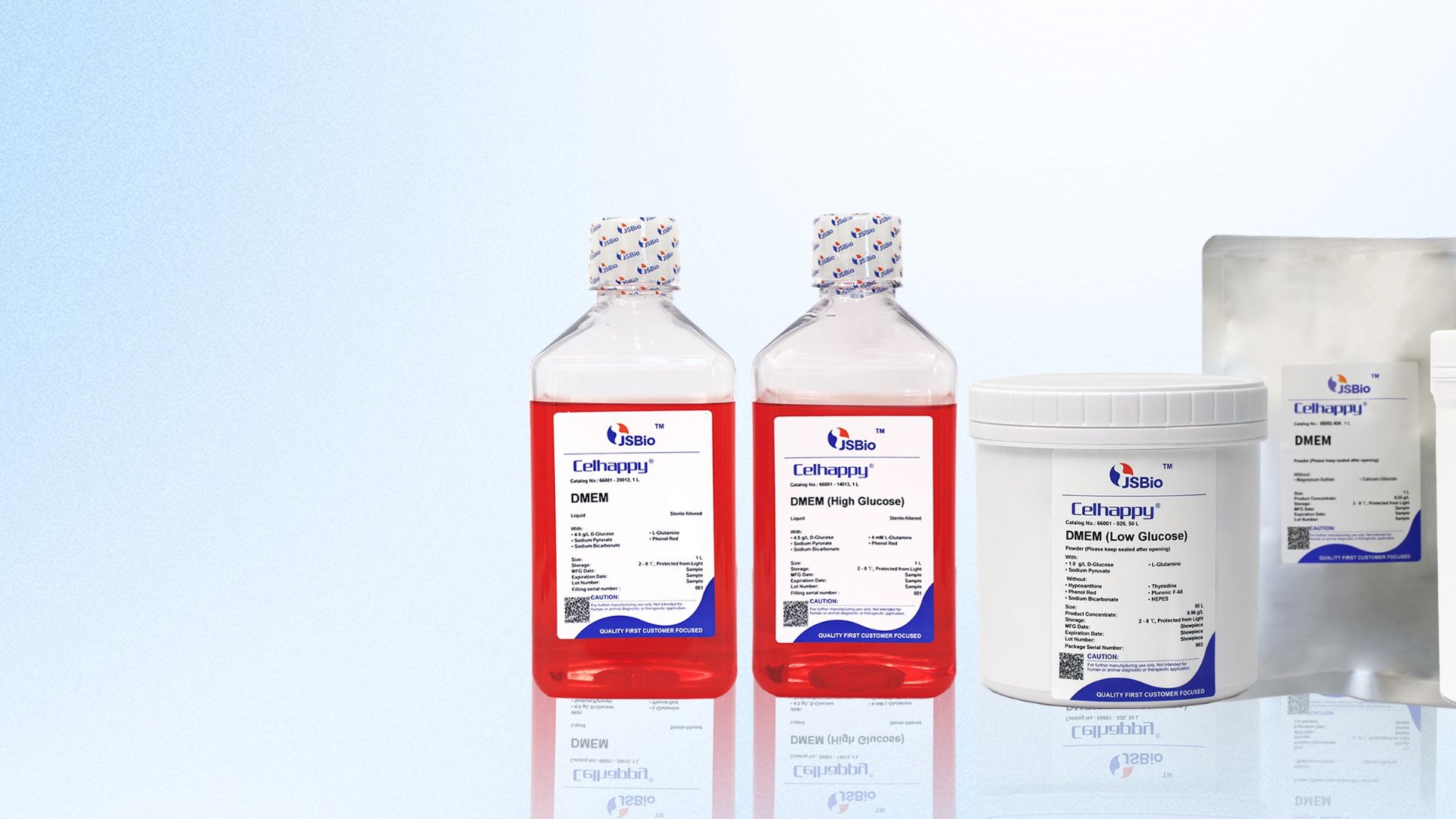
In cell culture work, the term “basal media” describes the nutrient-rich foundation that supports cell survival, growth and function. One of the most widely used basal media for mammalian cells is Dulbecco’s Modified Eagle Medium (DMEM) — and for good reason. Originally developed as a modification of Eagle’s Minimal Essential Medium (EMEM), DMEM features higher concentrations of amino acids and vitamins, multiple glucose formulations, and many custom variations to suit different cell lines and applications.
At CoPure, we offer DMEM in a variety of formats and formulations — high glucose, low glucose, with or without glutamine, with or without phenol red, with or without sodium pyruvate — allowing you to tailor the basal medium to the exact needs of your cell system. Here’s a deeper dive into what DMEM does, why the different formulations matter, and how to choose the right variant for your laboratory application.
What makes DMEM a versatile basal medium?
Elevated nutrient content
Compared to the original EMEM, DMEM was developed with approximately fourfold higher concentrations of amino acids and vitamins. This elevated composition gives DMEM greater flexibility across a wider range of cell types — from primary cultures to transformed cell lines.
Defined core components
A typical DMEM formulation includes:
A carbon source (glucose) in either low (≈1 g/L) or high (≈4.5 g/L) concentration.
Amino acids, vitamins, inorganic salts and buffer systems (often sodium bicarbonate) to maintain pH in a 5 % CO₂ incubator.
Optional additives such as sodium pyruvate, L-glutamine, and phenol red indicator, depending on the formulation.
Broad applicability
DMEM supports the growth of many cell types — primary fibroblasts, neurons, glial cells, endothelial cells (HUVECs), smooth muscle cells, and various immortalised lines such as HeLa, 293, Cos-7 and PC-12. Its flexibility and availability in different variants make it a “go-to” basal medium for many labs.
Why your choice of DMEM variant matters
When you see the table of DMEM variants (e.g., high glucose vs low glucose; with/without glutamine; phenol red; sodium pyruvate), they’re not just packaging differences — each one has practical implications.
Glucose concentration
High glucose (≈4.5 g/L) supports higher metabolic demand, faster growth rates, or cell lines with higher energy consumption. Low glucose (~1 g/L) is useful when your cells are sensitive to high sugar, or when you’re modelling physiological or metabolic stress conditions.
L-Glutamine presence or absence
Glutamine is a vital amino acid for cell growth and metabolism, but it is unstable and can decompose, generating ammonia. Some formulations omit glutamine to give you more control over supplementation and reduce by-product accumulation.
Sodium pyruvate
Pyruvate serves as an additional energy source and scavenger of reactive oxygen species. Including pyruvate can benefit certain cell types or stressed cultures; omitting it gives you a “cleaner” baseline if you want to control metabolic inputs precisely.
Phenol red indicator
Phenol red is a pH indicator present in many media. Its presence can help you visually monitor pH shifts, but for certain assays (fluorescence, imaging), you may prefer phenol-red-free versions to reduce background signal.
Powder vs liquid format
Offering DMEM in dry powder form ensures longer shelf-life and easier shipping for certain geographies. Liquid ready-to-use formulations streamline workflow but require cold storage and have a shorter shelf-life once opened.
How to select the right DMEM for your workflow
Know your cell type & application: Primary cells may be more sensitive; tumour lines may tolerate higher glucose.
Match metabolic demand: If you’re culturing rapidly dividing cells or performing transfections, high glucose + glutamine + pyruvate may help. For differentiation or metabolic studies, low glucose may be better.
Consider downstream assays: If you’re doing fluorescence microscopy, live-cell imaging or metabolomics, choose phenol-red-free versions or one without interfering additives.
Check supplement requirements: DMEM is a basal medium — it lacks proteins, growth factors or lipids, so you’ll typically supplement with 10 % FBS or defined alternatives.
Ensure appropriate buffer and CO₂ settings: Most DMEM uses sodium bicarbonate buffering and requires ~5 % CO₂. pH drift can compromise results.
Examples of DMEM variants we stock at CoPure
DMEM (High Glucose) – with glutamine, phenol red and sodium pyruvate (dry-powder or liquid)
DMEM (Low Glucose) – with glutamine, phenol red and sodium pyruvate
DMEM (High Glucose) – with glutamine and phenol red, without sodium pyruvate
DMEM (High Glucose) – without phenol red/without sodium pyruvate
DMEM (Low Glucose) – without glutamine and phenol red
These options mean you can align your basal medium precisely with your culture strategy — whether it’s for high-throughput screening, sensitive primary cultures, metabolic studies or defined-serum workflows.
Why sourcing your DMEM from CoPure matters
At CoPure, we ensure:
Consistent product quality and traceability
Local stock and fast shipment across Australia
Technical support to help you select the correct variant based on your cell line, workflow and downstream application
Capability to source both powder and liquid formats, giving you flexibility in budget, storage and usage
Whether you’re working with delicate primary neurons, robust carcinoma lines, induced-pluripotent stem cells or high-throughput screening platforms — choosing the right DMEM formulation is foundational. The right basal medium sets the stage: for optimal growth, reproducibility, metabolic fidelity and downstream assay integrity.
By offering a range of DMEM options — high vs low glucose, with or without glutamine, pyruvate, phenol red — CoPure empowers Australian labs to match their basal medium to their precise scientific goals.
Need help finding the right DMEM for your application? Reach out to our team at CoPure — we’ll guide you in selecting the best formulation, provide datasheets, and ensure you get it delivered swiftly across Australia.
For Further Enquiry Contact- sales@copure.com.au