Modern bioprocessing depends on efficient clarification. Whether processing cell culture harvests, fermentation broths, or other biological intermediates, removing suspended particles and process impurities is essential before downstream purification.
For manufacturers evaluating depth filters in Australia or lenticular filters in Australia, CoPure’s CSD Lenticular Filter provides a scalable depth filtration solution designed to combine high dirt-holding capacity, efficient particle retention, and long service life.
What Are Depth Filters?
Depth filters remove contaminants throughout the thickness of a porous filtration medium rather than capturing particles only on the surface.
This three-dimensional filtration mechanism allows the medium to retain particles of different sizes throughout its internal structure. As a result, depth filters can process fluids with relatively high particulate loads while maintaining useful flow rates.
They are commonly used for:
- Cell culture harvest clarification
- Fermentation broth clarification
- Bioprocess intermediate clarification
- Particle removal
- Reduction of host cell impurities
- Pre-filtration before membrane filtration
This makes depth filtration an important step between upstream processing and downstream purification.
What Is a Lenticular Filter?
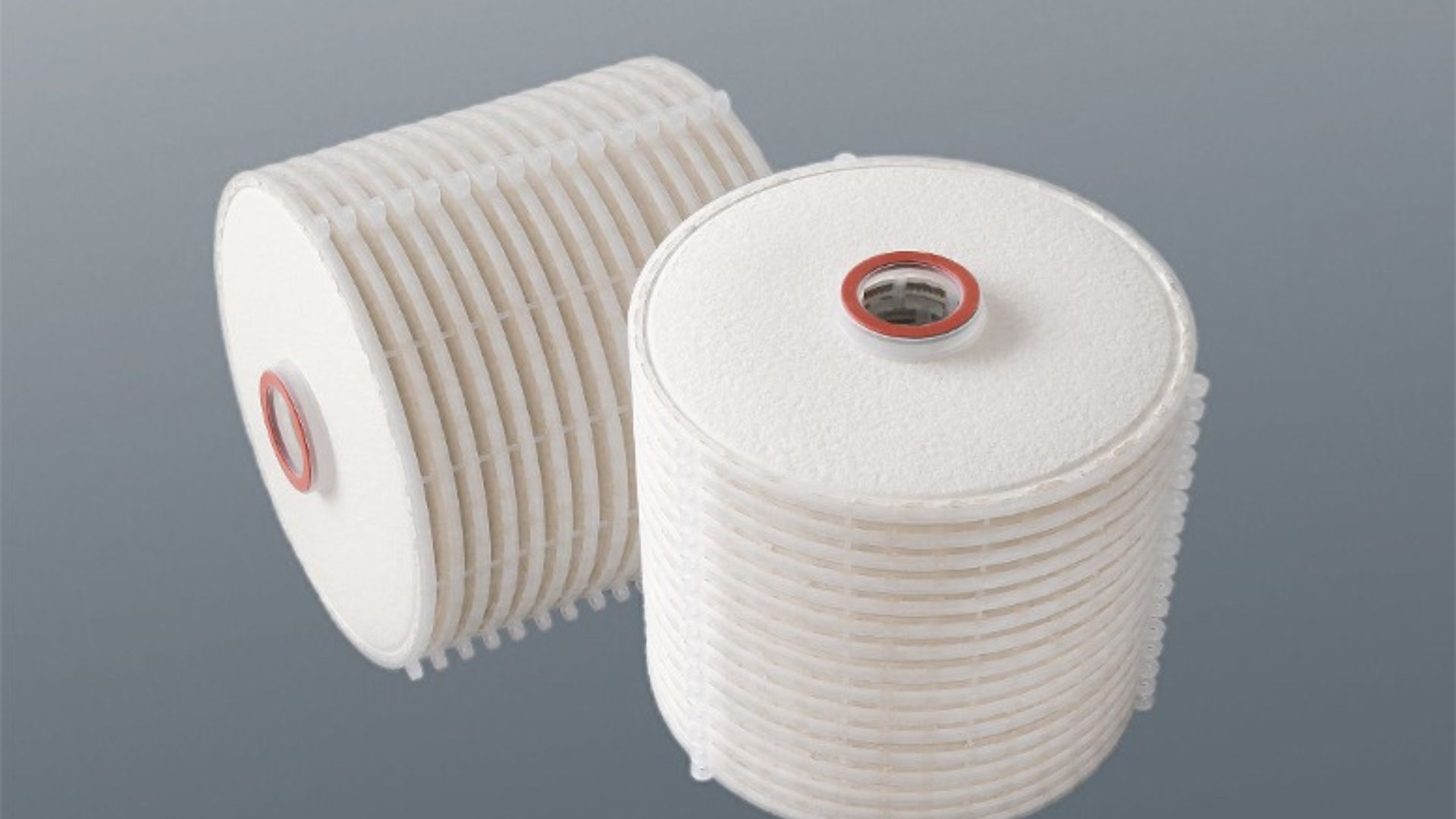
A lenticular filter is a modular depth filtration system made from stacked filter discs, known as lenses, enclosed within a housing.
Instead of using a flat filter sheet individually, multiple layers are assembled into a compact filtration unit. Increasing the number of lenses increases the available filtration area and processing capacity.
This makes lenticular systems particularly useful when laboratories and manufacturers need to scale filtration without completely redesigning their process.
CSD Lenticular Filter from CoPure
CoPure’s CSD Lenticular Filter uses a high-quality lignocellulose-based filtration medium combined with inorganic filter aids.
Its internal three-dimensional, crisscrossing structure provides multiple pathways for particle retention. The gradient structure enables larger particles to be captured earlier while smaller particles are retained deeper within the filter.
This design provides three important benefits:
High dirt-holding capacity: Contaminants are distributed throughout the depth of the medium rather than accumulating exclusively at the surface.
High retention efficiency: The gradient structure provides progressive particle capture across the filtration depth.
Longer service life: The filter can accommodate higher contaminant loads before reaching its operating limits.
Positive Zeta Charge for Bioprocess Impurity Removal
One of the notable characteristics of the CSD filter series is its positive zeta charge.
Many process-related impurities, including certain host cell-derived contaminants, can carry a negative charge. Electrostatic interactions between the positively charged filtration medium and negatively charged impurities can therefore contribute to their removal.
This can support the reduction of impurities such as:
- Host cell DNA (HCDNA)
- Host cell proteins (HCP)
- Fine particulate contaminants
Charge-based adsorption complements mechanical particle retention, making depth filtration particularly valuable in complex biological process streams.
Low Initial Pressure Difference and High Capacity
A filter’s initial pressure drop can influence filtration efficiency and available process capacity.
The CSD design provides a low initial pressure difference, helping maintain efficient flow as filtration begins. Its high dirt-holding capacity then allows the filter to accommodate increasing particulate loads during processing.
The specified CSD operating parameters include a maximum differential pressure of 2.1 bar at 25°C, a maximum operating temperature of 80°C, and a recommended pure-water flush volume of 50 L/m².
The specified flow rate is 10 L/min/m².
Operating conditions should always be selected according to the specific process, filter configuration, and manufacturer’s recommendations.
Scalable Filtration Area
One of the major advantages of lenticular filtration is scalability.
CSD filters are available in 12-inch and 16-inch diameters, with configurations ranging from 9 to 16 lenses.
For example:
| Configuration |
12-inch Area |
16-inch Area |
| 9 lenses |
0.9 m² |
2.1 m² |
| 12 lenses |
1.1 m² |
2.8 m² |
| 15 lenses |
1.4 m² |
3.5 m² |
| 16 lenses |
1.5 m² |
3.7 m² |
This range allows users to select a filtration area according to process volume and clarification requirements.
Wide Range of Retention Ratings
CSD filters are available in multiple removal ratings, ranging from approximately 0.02–0.2 µm through 7–18 µm, depending on the grade.
This broad selection allows filtration performance to be matched to the characteristics of the process fluid rather than relying on a single filtration grade.
The available options also include pharmaceutical, standard, and general-industry grades, supporting different application requirements.
Designed for Bioprocess Applications
CSD lenticular filters can be used in applications where reliable clarification is required, including:
- Cell culture clarification
- Fermentation broth processing
- Pharmaceutical intermediate clarification
- Biopharmaceutical purification workflows
- Host cell impurity reduction
- Pre-filtration before membrane filtration
The filters can also be steam-sterilised by autoclave at 121°C for 30 minutes, according to the supplied specifications.
Depth Filters vs Membrane Filters
Depth filters and membrane filters perform different roles.
Depth filters are particularly useful for fluids with high particulate loads because contaminants are retained throughout the filtration matrix.
Membrane filters provide more defined surface-based retention and are often used for finer filtration or final clarification/sterilising applications.
In many bioprocesses, using a depth filter upstream of a membrane filter can reduce the particulate burden reaching the membrane, helping protect downstream filtration capacity.
Choosing Depth Filters in Australia
When selecting depth filters in Australia, consider:
- Particle load – Highly turbid streams may require greater dirt-holding capacity.
- Required retention – Select a grade appropriate to the target particle and impurity profile.
- Process volume – Choose the appropriate lens number and filtration area.
- Fluid chemistry – Confirm compatibility with the process fluid and cleaning conditions.
- Downstream requirements – Consider how clarification will affect subsequent membrane filtration or chromatography.
Conclusion
For bioprocess manufacturers looking for lenticular filters in Australia, the CSD platform offers a combination of scalable filtration area, three-dimensional depth retention, high dirt-holding capacity, and positive-charge-assisted impurity removal.
By effectively clarifying biological process streams and reducing particulate and impurity loads before downstream purification, CSD lenticular filtration can form an important part of an efficient, scalable bioprocessing strategy.
FAQs
- What are depth filters used for?
Depth filters primarily clarify fluids containing suspended particles, cell debris, colloids, and other impurities. They are widely used in biopharmaceutical and industrial filtration.
- What are lenticular filters?
Lenticular filters are modular depth filtration systems made from multiple stacked filter layers or lenses. Adding lenses increases filtration area and processing capacity.
- What is the advantage of a CSD lenticular filter?
CSD filters combine a three-dimensional gradient structure with high dirt-holding capacity and positive zeta charge, supporting mechanical retention and adsorption of certain process impurities.
- Can CSD filters help remove host cell proteins and DNA?
The CSD medium’s positive zeta charge can help remove negatively charged impurities such as host cell DNA and may support host cell protein reduction, depending on process conditions.
- How do depth filters compare with membrane filters?
Depth filters retain contaminants throughout a porous matrix and are well suited to high-particulate-load streams. Membrane filters provide surface-based filtration and are commonly used for finer filtration stages. They can be used together in a multi-stage process.
For Further Enquiry Contact- sales@copure.com